
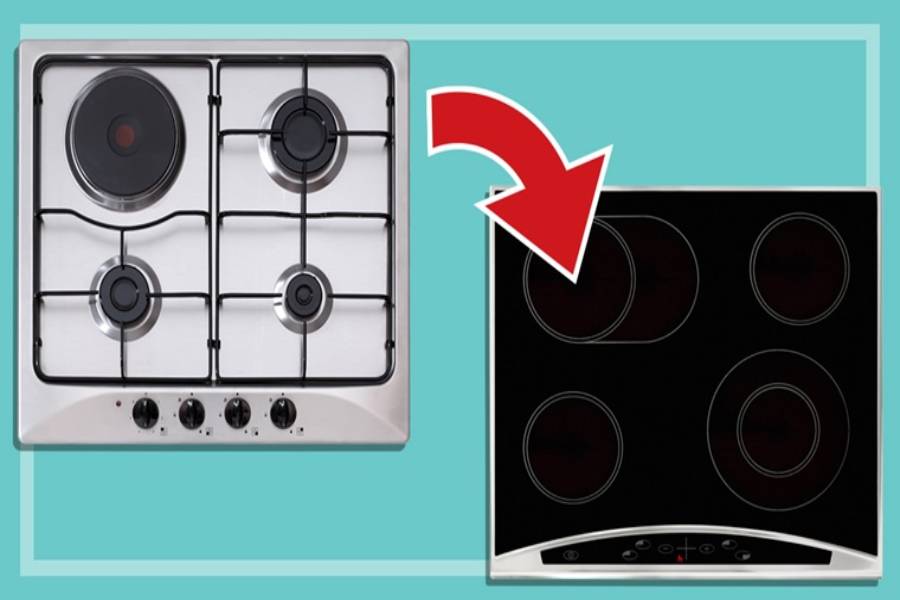
In the modern world, it's quite possible to choose a cooking appliance based on more than just price and convenience. It's important to consider how it will impact the environment, how much it will cost to run and maintain, and even how it might affect our health in the future.
A growing number of households are investigating alternatives to gas cooktops and gas heating due to warnings about the health risks associated with using gas, particularly for children and asthmatics. Rising gas bills and a desire to reduce reliance on fossil fuels have led many households to examine alternative energy sources.
Gas Vs Induction – Which Is More Efficient?
While many chefs and home cooks enthusiastically endorse their gas cooktops, the truth remains that induction cooktops surpass them in terms of efficiency. This is attributed to the fact that induction technology instantaneously channels energy into the base of the cookware, achieving a remarkable 85% efficiency rate. In contrast, cooktops reliant on gas-powered heating elements operate at a significantly lower efficiency of only 32%.
With induction cooking, the heat emanates directly from the cookware itself, rather than the cooktop, resulting in a quicker attainment of the desired temperature and subsequently faster food preparation.
To validate which cooktop heats pots most efficiently, Zsheme experts conducted a 'boil time test,' measuring the time it took to boil one liter of water using various cooktops. The results ranked induction as the most efficient, followed by gas and then ceramic.
One of the standout models in our induction cooktop review can boil a liter of water in just 2.37 minutes, whereas a gas cooktop may take four minutes or even longer, depending on the specific gas cooktop and the cookware being used.
Fiona Mair, the kitchen expert at Zsheme, points out that, much like gas, induction cooktops offer immediate responsiveness to temperature adjustments, though this may be less visibly evident compared to a gas cooktop. She explains, "Gas provides visual feedback when you raise and lower the flame, but with induction, you won't see any changes until you place food in the pan."
While not everyone may be willing to part with the allure of a flickering gas flame, esteemed chefs like Neil Perry and Shannon Bennett have become strong advocates for induction, even incorporating it into their own professional kitchens. Neil Perry highlights the advantages of induction, stating, "Cooking with induction is significantly faster, leading to a more efficient use of energy. This reduction in energy consumption has a substantial impact in a commercial kitchen."
Pioneering chef Analiese Gregory, who favors the use of a portable induction cooktop, expresses her viewpoint: "I'm all about fostering creativity and innovation in the kitchen – and that's why I'm a staunch supporter of induction. The shift away from gas is of paramount importance to me. I use a portable induction because it's swift, cost-effective, and I can easily take it with me wherever I go."


The Impact of Gas on Our Health
Compelling evidence demonstrates the significant contribution of gas cooktops to adverse respiratory health. What's most disconcerting is the impact this has on children. Michele Goldman, the CEO of Asthma Australia, states, "Gas cooktops account for 12% of the childhood asthma burden, which is equivalent to the effects of tobacco smoke within the home."
It's alarming to consider that something as routine as frying an egg can exert such a detrimental influence. While any type of cooktop can generate pollutants when you prepare meals, for instance, the smoke that emerges when a pan heats up, Goldman underscores that gas cooking poses the greatest concern. This is because burning gas emits additional pollution in the form of harmful gases and particulate matter.
Goldman elaborates on the array of contaminants released by a gas cooktop that can adversely affect your health, such as nitrogen dioxide, formaldehyde, and fine particulates that can penetrate deep into the airways and even enter the bloodstream. Therefore, the repercussions extend beyond just lung health to impact other vital organs.
For individuals living with asthma or those with family members who do, Goldman recommends several measures. These include always ensuring proper ventilation in the kitchen, utilizing a rangehood, keeping doors and windows open during gas cooking, and, if possible, restricting children's access to the kitchen during this time.
Additionally, deploying an air purifier equipped with a HEPA filter in the cooking area can significantly mitigate the presence of pollutants. A 2014 study affirmed that air purifiers equipped with HEPA and carbon filters can notably reduce nitrogen dioxide levels in the kitchen environment.
Gas Vs Induction: Which Cooks Better?
Adapting to an induction cooktop may involve a short learning curve, including familiarizing yourself with the appropriate pan sizes for each cooking zone and understanding the functionality of safety features like child-lock and safety cut-out (advantages that induction offers over gas). However, once you've acclimated to it, you'll notice minimal variance in cooking outcomes. In fact, you might even find that meals are ready more swiftly, thanks to the enhanced efficiency of induction cooking.
The key consideration when selecting an induction cooktop is to opt for one with a diverse range of cooking zone configurations. It's essential to ensure that the base of your pans closely matches the designated cooking zones, ensuring full contact between the base and the induction zone. This is crucial because the pan itself is directly heated, and better contact leads to more effective heat transfer. Using a pan with a smaller or larger diameter than the induction zone can result in a weaker magnetic field and reduced heat output.
"If you're in the market for a new induction cooktop, opt for one that offers a variety of cooking zones in different sizes, including extra-large, flexi zones (enlarged single zones that accommodate pans of any size placed within them), and small cooking zones, as these cater to a broad spectrum of cookware sizes."
While some cooks may miss the dedicated wok burner commonly found on gas cooktops, there is the option of acquiring flat-bottomed induction woks designed for use on induction cooktops. These woks can easily achieve the necessary high heat levels for effective stir-frying. Rather than tossing the ingredients in the wok, you simply need to employ a cooking utensil to move the food around.
Induction Is Easier to Clean
For those who've spent hours grappling with the intricate burners and trivets on a gas cooktop, maintaining an induction cooktop is a breeze in comparison. Induction cooktops, featuring a knob-free, unbroken glass surface, are typically far more straightforward to clean.
Fiona elaborates that even if you happen to spill food on an induction cooktop, it won't bake onto the surface, rendering it nearly impossible to remove, a predicament all too common with gas and ceramic cooktops. This is due to the fact that induction cooktops do not heat up the cooking surface, making spill cleanup significantly more manageable.
"On the downside, sugary substances can adhere to the glass, potentially creating an uneven surface, and you might need to procure a specialized cream to ensure your cooktop remains streak-free and to eliminate any marks left by pans," notes Fiona. "Also, touch controls may become unresponsive if they accumulate grease from cooking splatters."
When evaluating cooktops, Zshemeexperts consistently assess each model's "Ease of Use," which encompasses an evaluation of how simple it is to clean. In this aspect, induction cooktops consistently outperform other types, making the cleaning process much more convenient.
Installation Considerations
Induction cooktops not only come with a potentially high upfront purchase cost, but the expenses associated with their installation can also be significant. Additionally, it's essential to ensure that your home's power supply can meet the wattage requirements of the cooktop you intend to purchase.
While most induction cooktops are designed to be compatible with standard power supplies, Fiona advises checking the specific power demands of the appliance you're interested in. In cases where your current home power supply falls short of accommodating the additional power requirements, the associated expenses can be substantial.
"Typically, a standard home plug provides a 10 Amp connection, whereas an induction cooktop may necessitate a 20A, 32A, or even a 42A connection. If your home lacks an existing connection for these requirements, a licensed electrician will need to perform hard-wiring. You might also require an additional circuit to support the higher wattage, incurring further costs," she explains.
Will Switching to Induction Save You Money?
The advantages of an induction cooktop clearly outweigh those of a gas cooktop in many aspects. However, does the transition from gas to induction result in long-term cost savings?
"Induction is undoubtedly more cost-effective to run than gas, but due to the higher initial purchase and installation expenses for induction, immediate and substantial savings are unlikely," explains Chris Barnes, an expert at Zsheme. "The potential for significant savings arises when you transition away from gas for all your household appliances – for cooking, heating, and hot water. If you also install an efficient solar power system and make wise use of it, long-term savings are essentially guaranteed."
While we cannot provide an exact cost comparison between gas and induction cooktops, the Climate Council has estimated that households can save between $500 and $1900 annually (depending on local gas prices) by entirely shifting from gas and discontinuing the gas connection. It's crucial to emphasize the importance of disconnecting your gas supply because, even if you don't use it, you might still incur hundreds of dollars each year in supply charges.
It's evident that abandoning gas is a prudent choice for those who are budget-conscious, especially given the upward trajectory of gas prices, influenced by various global factors.
"The best we can hope for regarding gas prices is stabilization," Barnes remarks. "It's more likely that gas prices will continue to rise over time, and the era of the inexpensive gas prices seen in past decades, which once made gas an attractive choice, may never return."